
soul
where thousand words begin.
images demand a longer look to reveal their hidden truths
The Vision: 12 Chapters in Light
As a commercial photographer with over 30 years of advertising expertise, I am pushing the boundaries of the medium with a groundbreaking new series. Twelve conceptual images—unlike anything done before—tell a complete, symbolic story. With the first two masterworks complete, the journey continues for the remaining ten.
Can a single, static frame tell a story as rich as a song or a film? This series is born from the desire to create imagery where every element is a deliberate syllable in a larger narrative. I explore the boundaries of identity, perception, and the weight of our environment.
The Concept: The Impossible Double
The central figure is a visual paradox: a "new sister" created by the literal reflection of each twin’s half-face. This mirrors the Cantonese proverb: “若要人似我,除非兩個我”—the idea that no one can truly be like you unless there were two of you. By joining them through a mirror, the image captures a "self" that is both whole and an illusion.
Symbolism and "The Wall"
Drawing inspiration from the institutional themes of Pink Floyd’s The Wall, the setting is a meticulously staged landscape of social commentary. Every object within the frame is a deliberate symbol:
● The Classroom: A representation of the rigid structure and relentless pressure inherent in the educational system.
● The Calligraphy: These serve as the literal "slogans of life"—the rules and dictums that dictate what we must do and who we must be.
● The Overstuffed Drawer & Towering Workbooks: A visual protest against the "spoon-fed" education style often found in Eastern cultures, where individuality is often buried under a mountain of repetitive labor.
● The Clock: Beyond being a silent observer of discipline and passing time, the clock serves as a hidden peace sign. It suggests that true peace begins only when we acknowledge the temporal and physical differences between human beings, rather than forcing everyone into the same mold.
The Philosophy of the "One Shot"
In an era of digital manipulation, I insist on pure photography. Aside from the digital composition of the clock (to protect the fragile, peeling classroom wall), this image was captured in a single shot.
I chose this difficult path because if "seeing is believing," I want to challenge what we believe. Even when the camera captures a physical reality, it can still represent a 鏡中花,水中月 (flower in a mirror, moon in the water)—a beautiful illusion. It serves as a reminder that our accumulated knowledge can sometimes become a 知識障 (intellectual obscuration), blocking us from seeing the true essence of reality.


see. shoot. | visual dialogue
"Another Me - Twins"


unretouched plates
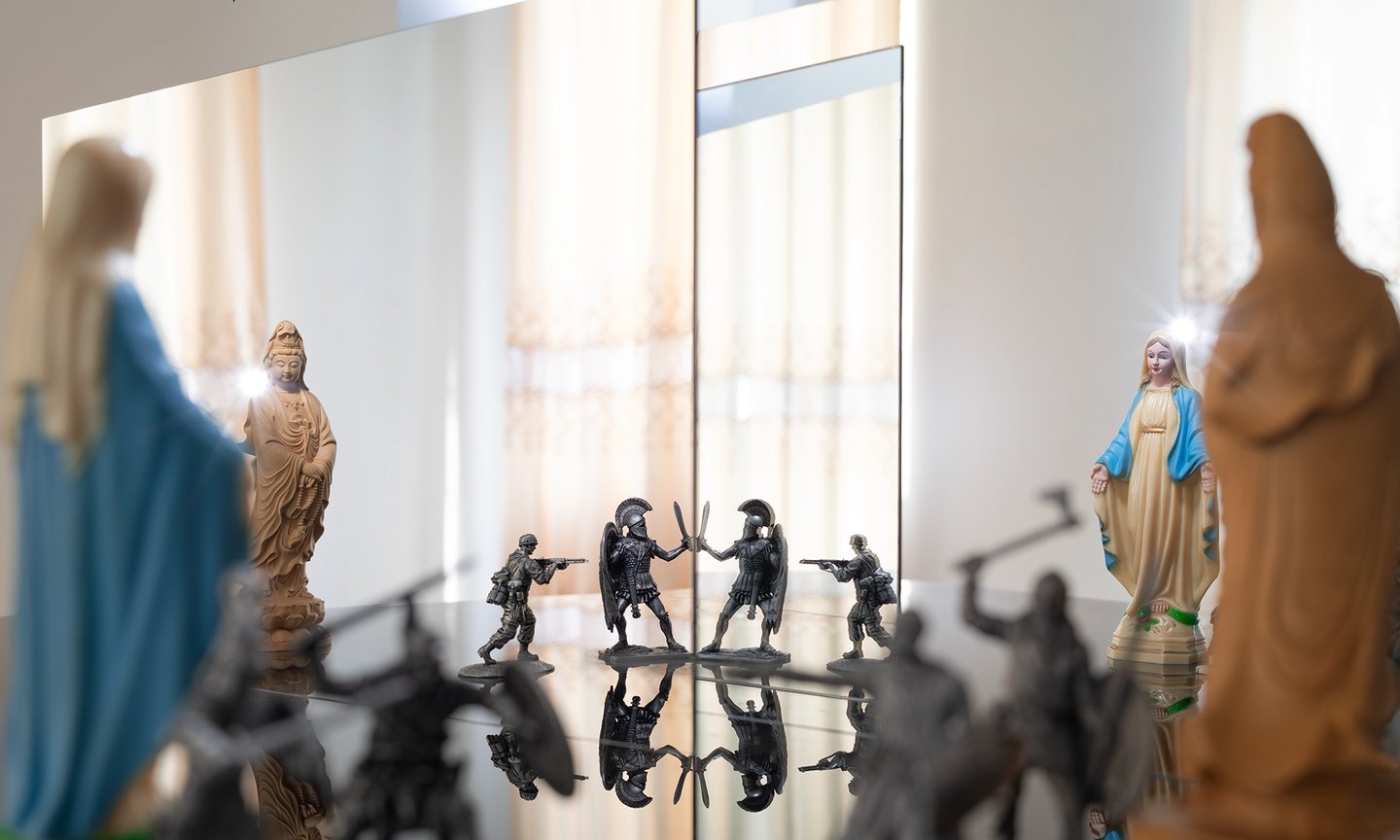
Can faith and identity survive the clash of cultures and the violence of human nature? This second installment of the series draws from my childhood in Hong Kong—a city defined by the intersection of British colonial influence and Eastern tradition. It is an exploration of whether our spiritual divisions are merely matters of nomenclature.
The Concept: A Household of Dual Faith
Growing up, my home was a sanctuary for both Western and Eastern divinity. With a grandmother who practiced Buddhism and a father who was Catholic, the icons of GuanYin and the Virgin Mary stood side-by-side. I was raised on stories of their shared virtues: kindness, mercy, and forgiveness. This piece asks the question: What if we all believe in the same God, but simply give that Grace a different name?
Symbolism: The Ghost in the Mirror
While the divine figures look on, the center of the frame is dominated by conflict:
The Ares-like & Modern Soldiers: These figures represent the timeless cycle of human warfare—the "God of War" manifesting in both ancient and modern forms.
The Mirror Reflection: The soldier fights his own ghost-like reflection. This is a meditation on the ego and the afterlife. It poses a haunting possibility: What if the enemy we fought were just another "me"? What if, in the end, there is no individual soul—only the reflection of the violence we leave behind?
The Technical Reality: The Power of the "One Shot"
Following the strict philosophy of the "Twins" variant, this image is a one-shot capture. There is no AI-generated content or digital compositing. The complex alignment of the religious icons and the battling figures—complete with their ghost-like reflections—was achieved through the precise physical placement of front-surface and second-surface mirrors. By meticulously calculating these angles, the commitment to "One Shot" photography reinforces the theme of "Seeing is Believing." It forces the viewer to confront a tangible, physical reality that purposefully mimics a spiritual illusion.
see. shoot. | visual dialogue